
- Automotive and Engineering Technology
- Communication
- Data Science
- English
- Graphic Communications
- Human Resources
- Mathematics
- Teaching & Leadership
- Technology & Workforce Learning
-
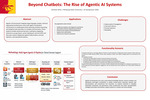
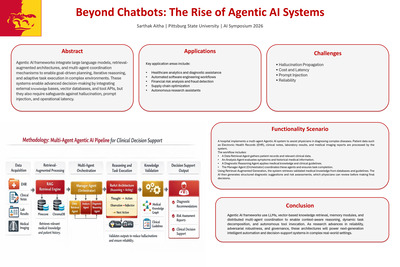
Beyond Chatbots: The Rise of Agentic AI Systems
Sarthak Aitha
Agentic AI frameworks integrate large language models, retrieval augmented architectures, and multi-agent coordination mechanisms to enable goal-driven planning, iterative reasoning, and adaptive task execution in complex environments. These systems enable advanced decision-making by integrating external knowledge bases, vector databases, and tool APIs, but they also require safeguards against hallucination, prompt injection, and operational latency.
-
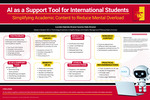
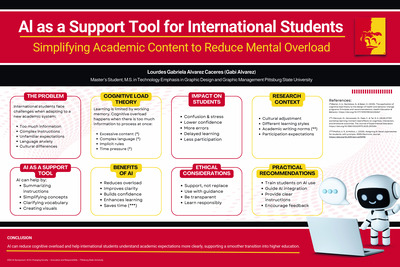
AI as a Support Tool for International Students
Gabi Alvarez and Derrel Fincher
This poster presentation explores the use of Artificial Intelligence (AI) tools to enhance teaching, learning, and communication in higher education, with a special focus on supporting international students. Demonstrating how AI can serve as a supportive tool to foster inclusion, improve communication, and enhance learning experiences for diverse student populations. Drawing on my experience as a Graduate Teaching Assistant in the Department of Teaching and Leadership at Pittsburg State University, this project examines how AI-supported strategies can help bridge language barriers, clarify academic expectations, and improve student engagement. Many international students arrive at PSU with strong academic backgrounds but must adapt to a new educational system, teaching styles, and communication norms. AI tools can support this transition by helping instructors simplify complex content, generate visual explanations, and provide multilingual support while maintaining academic rigor. Additionally, as a graduate student in Graphic Design and Graphic Management, I am interested in how AI assisted visual communication and instructional design can improve comprehension and accessibility. This project highlights practical applications such as AI generated visual aids, structured content summaries, and adaptive learning supports that enhance clarity without replacing the instructor’s role. The poster presents examples, potential benefits, ethical considerations, and best practices for integrating AI responsibly in higher education.
-
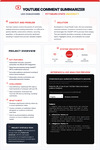
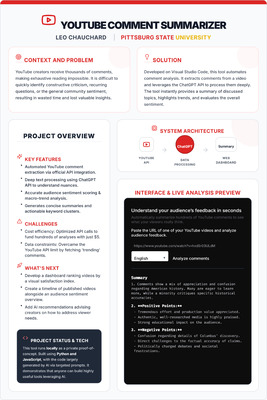
Youtube Comment Summarizer
Leo Chauchard
This project introduces an AI-driven web platform designed to transform the massive, often disorganized volume of YouTube comments into structured, actionable insights. In the current digital landscape, video creators and companies struggle to manually process thousands of user feedbacks. This application leverages Natural Language Processing (NLP) and Large Language Models (LLMs) to automatically scrape, analyze, and summarize the 'collective voice' of a video’s audience.
-
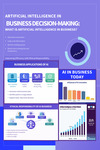
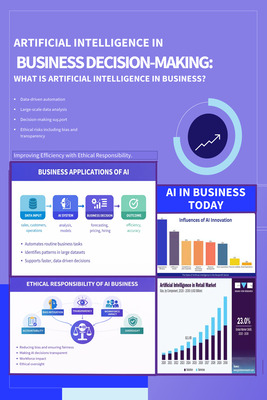
Artificial Intelligence in Business Decision Making: What is Artificial Intelligence in Business?
Amanda-Michelle Cowan
Artificial intelligence (AI) has become a transformative force in modern business administration, reshaping decision-making processes, operational efficiency, and organizational strategy. As businesses generate increasingly large and complex datasets, AI-driven systems provide analytical capabilities that exceed traditional methods, enabling organizations to identify patterns, forecast trends, and respond proactively to changing market conditions. This presentation examines how artificial intelligence functions as a decision-support tool across key business areas, including finance, marketing, human resources, and operations. It highlights the benefits of AI-enabled analytics, automation, and visualization tools that improve accuracy, reduce human error, and enhance managerial consistency. While these advancements offer significant competitive advantages, the presentation also emphasizes the ethical challenges associated with AI adoption. Issues such as algorithmic bias, data privacy, transparency, misinformation, and workforce impact are explored to demonstrate why responsible AI governance is essential. Drawing on academic research and industry reports, this project argues that ethical oversight must be treated as a strategic business responsibility rather than an optional safeguard. Ultimately, the presentation advocates for a balanced approach in which innovation and ethical accountability work together to ensure sustainable, trustworthy, and effective AI implementation in business environments.
-
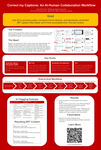
Correct my Captions: An AI-Human Collaboration Workflow
Derrel Fincher
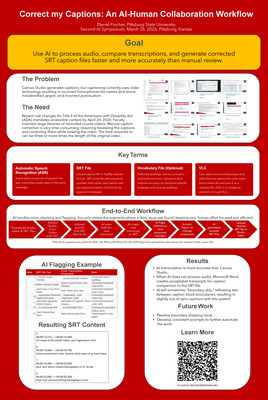
As the April 24, 2026 ADA Title II deadline approaches, higher-education instructors are facing the task of improving captions on existing course videos. This poster presents a practical workflow to improve Canvas Studio captions in which AI performs most of the cross-checking between two independent transcripts: the original Studio captions and an AI-generated transcript from the extracted audio. The AI compares the transcripts and uses differences as a quality-check signal: segments with strong agreement remain unchanged, while mismatches, “inaudible/uncertain” markers, and glossary terms (names, acronyms, technical vocabulary) are automatically flagged for targeted human review. After review, the workflow outputs a revised caption file, optionally removing filler words, while preserving timing and updating caption text where warranted. The goal is a scalable, instructor-friendly approach that concentrates human effort where it adds the most value.
-
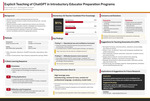
Explicit Teaching of ChatGPT in Introductory Educator Preparation Programs
Emily George and Lotta Larson
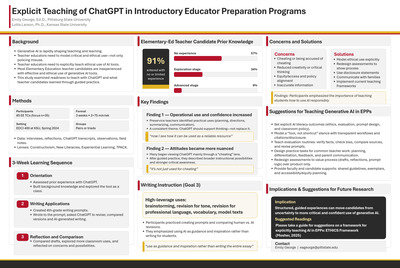
I will share success stories on what works in the field, teacher candidate & classroom teacher feedback on ease of use and effectiveness for task. Will provide a list of field-tested ideas to ease the workload of general and special education teachers.
-
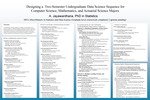
Designing a Two-Semester Undergraduate Data Science Sequence for Computer Science, Mathematics, and Actuarial Science Majors
A. Jayawardhana
The proposed two-semester sequence is designed to provide students with a rigorous foundation in statistical thinking, computational modeling, and modern machine learning. The curriculum integrates probability, inference, optimization, and algorithmic learning into a coherent framework for data-driven decision-making. The sequence progresses from statistical foundations to computational machine learning systems, emphasizing both theory and implementation.
-
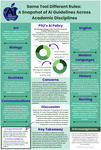
AI Same Tool Different Rules: A Snapshot of AI Guidelines Across Academic Disciplines
Mary Larsen and Mercedes Dowdy
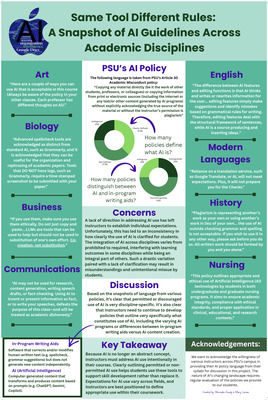
Since its earliest emergence, universities across the nation have been struggling to create a universal policy surrounding the use of generative AI tools such as ChatGPT. This poster will examine the limitations of a universal, one-size-fits-all AI policy in academic contexts, particularly across disciplines where different pedagogical goals, assessment practices, and ethical concerns exist. Drawing on student reactions to existing AI policies and a critical review of PSU’s current AI guidelines, this project highlights how vague or inconsistent language leads to inconsistent interpretation, uneven enforcement, and most important student confusion on the use of AI in their academic studies. The poster argues for a more flexible, context-aware approach to AI governance –one that emphasizes transparency, instructor autonomy, and ongoing policy revision rather than rigid prohibitions. The ambiguity of AI creates the need for a precise definition of what constitutes AI use and clear parameters of approved and prohibited uses at the course level, even varying within disciplines. By showcasing student perspectives and institutional realities, this project aims to promote meaningful discussion about the responsibility for instructors—not the university—to create clear and specific AI policies to ensure that AI supports learning rather than causing confusion or undermining a student’s educational experience.
-
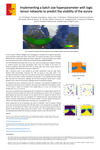
Implementing a batch size hyperparameter with logic tensor networks to predict the visibility of the aurora
Erik Mayer, Jhonatan Granadeno, Jacob Luton, Ty Woolven, Estevan Hernandez, Tao Wu, Hongsheng He, and Elizabeth MacDonald
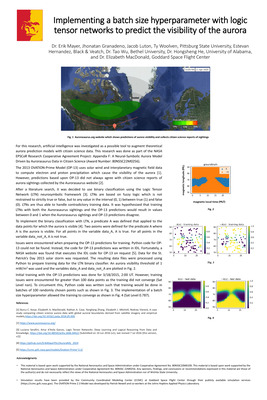
In this research, Logic Tensor Networks (LTNs) are used to predict the visibility of the aurora. LTNs implement first-order logic using neural networks. LTNs were used in the classification of conditions for which the aurora could be visible. However, due to the large amount of training data, the LTNs experienced convergence issues during training. To resolve these issues, a batch size hyperparameter was implemented for which only a subset of the training vectors was used each epoch. This allowed the training of the LTNs to successfully converge.
-
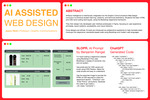
AI Assisted Web Design
Jason Reid
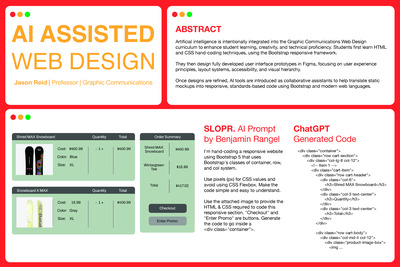
This poster presentation explores how artificial intelligence is integrated into the Graphic Communications Web Design curriculum to enhance student learning, creativity, and technical proficiency. Students first design fully developed user interface prototypes in Figma, focusing on user experience principles, layout systems, accessibility, and visual hierarchy. Once designs are refined, AI tools are introduced as collaborative assistants to help translate static mockups into responsive Bootstrap-based code.
-
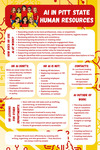
AI in Pitt State Human Resources
Lori Scott Dreiling
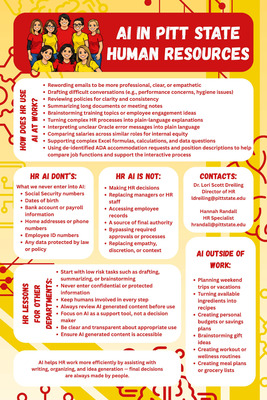
In the poster, we plan to share how Human Resources at Pittsburg State University is thoughtfully exploring the use of artificial intelligence (AI) as a supportive tool in our daily work. Our focus is not on replacing human judgment or decision making, but on using AI to improve efficiency, clarity, and consistency while keeping people at the center of every HR process. We will highlight practical ways we use AI to assist with tasks such as rewording emails for professionalism and empathy, summarizing lengthy documents or meeting notes, interpreting complex Oracle system messages, supporting Excel calculations, and translating complicated HR processes into plain language.
We also will discuss how AI can support brainstorming training topics, reviewing policies for clarity and consistency, and assisting with internal equity discussions when only de identified data is used. Alongside these use cases, we'll clearly define our boundaries for responsible AI use. We outline what AI is not, such as a decision maker, a replacement for HR professionals, or a system for accessing employee records, and identify the types of sensitive information that are never entered into AI tools.
By sharing both how we use AI and how we do not use it, this poster aims to build transparency, trust, and confidence in responsible AI adoption within HR. Our goal is to demonstrate how AI can support HR professionals while preserving confidentiality, compliance, and human judgment.
-
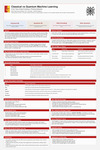
Classical vs Quantum Machine Learning: A Fair Test of Data Encoding in Phishing Detection
Muhammad Huzaifa Shafique
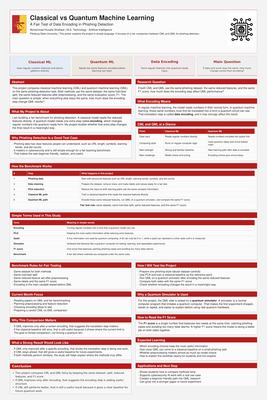
This is a planned study that compares how much does data encoding techniques affect Quantum Machine Learning (QML) performance compared to Classical Machine Learning (CML)? Unlike classical models, QML cannot directly read a dataset; it must first convert features into quantum states using conversion methods like Classical machine learning reads normal numbers directly, but Quantum machine learning first turns those numbers into quantum form (qubits) that can be present in multiple states at once. This strengthens core AI skills for data preprocessing, PCA (Principal Component Analysis) features, model training, and evaluation. These are the basic building blocks of both approaches, then testing them on the same data. I will compare common classical baselines against QML approaches to run on a simulator and will report prediction quality (F1 score). Moreover, practical evaluations like testing multiple encoding techniques under the same experimental conditions and focusing on encoding driven behavior and publishable contribution as it clearly guides which encoding works best for which dataset conditions. The poster will define the main terms for both CML and QML, showing how they are related to explaining the major differences. The project produces clear plots, and guidelines on which encoding choices are most reliable for security style datasets. Concerning education, this can be used as a teaching resource for AI evaluation and emerging QML workflows. In conclusion, this comparative analysis for a small AI and Security task (phishing detection using a tabular dataset of URL/email features) demonstrates strong skills in machine learning, and emerging QML tools that are valuable for research and development.
-
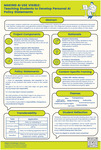
Making AI Use Visible: Teaching Students to Develop Personal AI Policy Statements
Megan Stoneberger Johnson
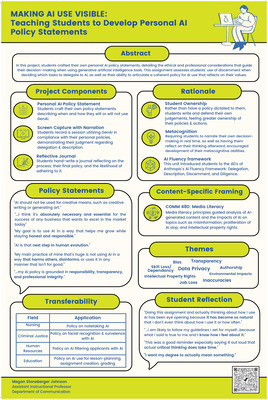
Students are rapidly adopting generative AI tools to perform a myriad of academic and personal tasks, often without much critical thought or ethical deliberation. Without clear guiding principles or predetermined standards of practice, some students are bypassing the cognitive work learning requires and robbing themselves of meaningful intellectual development. To break the cycle of mindless AI use, I developed a project in which students craft their own personal AI policy statements that detail the ethical and professional considerations that guide their decision making. Students are required to model their AI use through a narrated screen-capture video that demonstrates their prompt-crafting and refinement, bringing transparency to the process and encouraging intention and reflection. Finally, students compose handwritten reflective journals that demonstrate their metacognition regarding the process. This poster presentation will include assignment details, rationale, and outcomes that can be transferred to a variety of academic courses.