


Files
Download Full Text (198 KB)
Description
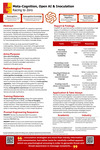
A 2023 study explored ChatGPT-4's capacity to generate inoculation message treatments, revealing structural weaknesses like unclear language and inconsistency in developing threat components. Trained with diverse prompts, the AI struggled with explicit forewarnings and limited refutations, despite showcasing originality and figurative language use. This highlighted the need for improved generative AI inoculation message design. In 2025, follow-up studies examined ChatGPT-4o’s metacognition. Researchers used chain of thought prompt engineering techniques to elicit knowledge, regulation, and experiences, analyzing AI's self-assessment and adaptability. ChatGPT-4o reported various confidence levels including a high degree of confidence in refining messages for readability, acknowledging and correcting prior structural weaknesses. Novel message generation and language ratio adherence garnered moderate confidence. Creating new communication strategies yielded the lowest confidence and was deemed dependent on clear goals and constraints. This line of inquiry highlights parallels between inoculation theory and AI metacognition. Inoculation's threat mechanism maps to AI's error anticipation, while counterarguing mirrors AI's monitoring and evaluation. Guided practice in inoculation corresponds to chain-of-thought prompting, enhancing AI’s problem-solving. This suggests inoculation principles can inform AI metacognitive prompts, fostering self-reflection and adaptability, and highlighting cross-disciplinary potential to improve both human communication strategies and AI development. Applications and implications for industry and higher education are documented.
Department of Primary Author
Communication
Affiliation of Primary Author
Faculty
Publication Date
2025
Recommended Citation
Mason, Alicia, "Meta-Cognition, Open AI & Inoculation: Racing to Zero" (2025). Posters. 4.
https://digitalcommons.pittstate.edu/ai-posters-2025/4